

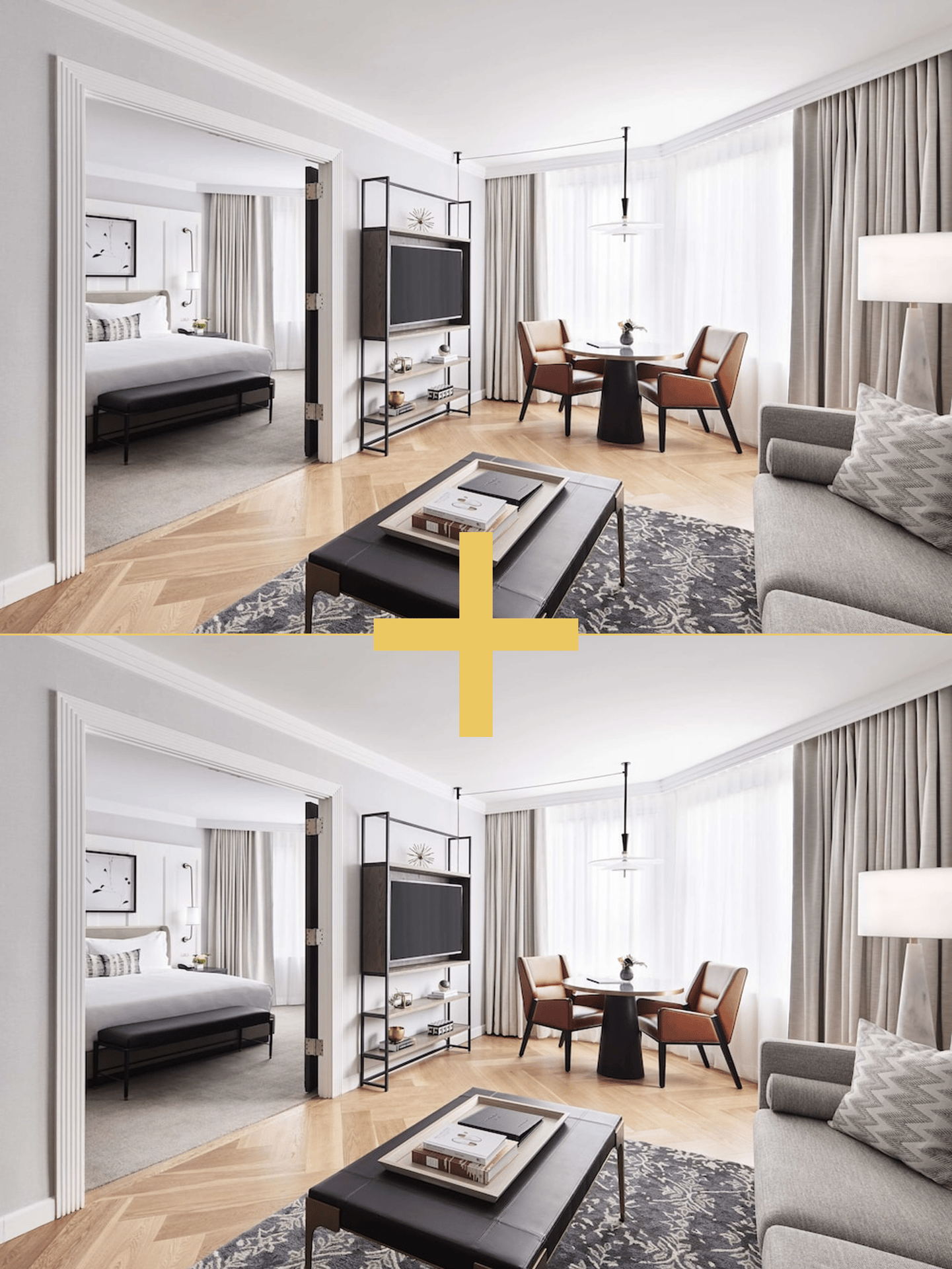
What hotel staff mean when they say "adjoining"
Sometimes it means a door. Usually it means a shared wall. Here's why the word keeps ending up in confirmation emails, and the one question that settles it.
You booked two rooms for the family, asked for them to be together, and the confirmation says "adjoining rooms requested." It sounds like the thing you wanted. Often it isn't, and the difference only shows up at check-in, when you find the kids are on the other side of a wall with no way through.
The words, as the industry mostly uses them
| Term | What it usually means | Door between the rooms? |
|---|---|---|
| Connecting | Two rooms joined by an interior door. Each also has its own door to the corridor. | Yes |
| Adjoining | Two rooms side by side that share a wall. | Usually not |
| Adjacent | Two rooms near each other: next door, across the hall, or a few doors down. | No |
| Lock-off suite | A suite that can be split into two separately lockable units, or sold whole. | Yes, inside the suite |
| Two-bedroom suite | One unit with two bedrooms, generally with a shared living area. | Bedroom doors, one entrance |
The important word in that table is "usually." Hotels, booking sites and staff don't use these terms consistently. Some properties say "adjoining" when they mean connecting. Some booking sites put both under one filter. Some front desks use whichever word comes to mind. So the word on its own doesn't tell you what you're getting.
Why it ends up in your confirmation
Most hotels don't sell connecting rooms as a room type. They sell two ordinary rooms and record a preference that they be connected, adjoining or near each other. A preference isn't an allocation. It's a note that someone will try to honour at check-in, once they know which rooms are empty and whether the people already in the room next door are staying another night.
That's why the wording drifts. Whoever typed the note picked a word, and the confirmation email repeats it back to you. The email isn't promising a door. It's telling you what was asked for.
The one question that settles it
Ask the hotel directly:
Will there be a door inside, between the two rooms, and is that guaranteed on the reservation or a request?
"Door inside" removes the ambiguity in "adjoining." "Guaranteed or a request" tells you whether to make a backup plan. If the answer is "we'll do our best," you have a request, however it's worded.
Two follow-ups are worth asking if you get a yes:
- Are the room numbers assigned now? A guarantee usually means a specific pair has been set aside. If no rooms have been assigned yet, the hotel is still deciding.
- Are both rooms the same type? Connecting pairs often join a king room to a two-queen room, or a suite to a standard room. Make sure the beds work for your group.
How the door itself works
A connecting door is normally two doors, one on each side of the wall, each locked from its own room. Both have to be open for anyone to pass through. That's what makes connecting rooms work for families with older children or for two couples: either side can close off its room without asking the other. With young children, check that you can reach and work the lock on your side.
Where Suiteness fits
We only list a pair as connecting when the hotel will put the door on the reservation, so a connecting room on Suiteness is a specific pair of rooms, not a preference. If you'd like the long version, our connecting-rooms explainer goes through how that works and what to expect at check-in.
Search connecting rooms where the door is on the reservation rather than in a comments field.